


Urban Defence Unit GmbH
Prevention and Preparedness Measures, Contingency Planning
(Why prepare now?)
Global uncertainty due to disasters, crises, and wars
In an era of increasing global uncertainties, shaped by numerous conflicts and flashpoints, governments, authorities, and officially mandated organizations are currently focused on maintaining public order. However, the question arises whether everything and everyone can truly be protected and supported by official side in an exceptional situation.




Protection and Safeguarding of Life and Assets
Beyond the challenge of how people can survive in an exceptional situation—for example, without electricity, water, gas, and with limited supplies—the question also arises as to how real estate, goods, private assets, and companies, as well as hospitals, medical practices, and tax or law firms, can be protected and preserved. In such cases, state support will fall back to a minimum, as emergency programs for disasters and war only provide for the protection of vital critical infrastructure.
Escalation plans for electricity, water, gas, communication, supply and mobility

Prevention and Contingency Planning

Shielding and Protection of Assets
Building security, material and process protection for the operational continuity of companies and private infrastructure

Defense and Defensive Measures
Defense against external influences
Analysis of State Institutions
The behavior of the population during past crises and disasters has been extensively analyzed and is available, among others, as a scientific study by the Federal Office of Civil Protection and Disaster Assistance (BBK) under "Population Behavior in Crises/Disasters." Based on existing analyses and personal experiences (such as the 2021 flood disaster in Hagen), as well as relevant crisis concepts from federal and state governments, private universities, and the personal expertise of the Urban Defence Unit team, current-state analyses are conducted and subsequent implementation concepts are developed. Concepts, strategies, and their impact on people, assets, and companies are regularly refined and adapted.
To this end, preventive approaches and solutions are offered in the form of "Emergency Files" and operational guidelines on how to prepare for crises, disasters, and war in order to reduce dependency on state authorities and emergency regulations. For all "exceptional situations," Urban Defence Unit also maintains a network of suppliers providing material, equipment, and goods for crisis and disaster scenarios, as well as legally compliant defense options. Within the framework of contractual agreements, both the "Emergency File" and the "Emergency Kits" (material, technology, and mechanics) are reviewed annually (or at fixed intervals), updated, and adapted to actual developments and changing circumstances.
Supply Security as a Competitive Factor
For companies today, efficiency alone is no longer sufficient—resilience is equally critical. Production stoppages, supply delays, and data losses can result in significant costs within hours and damage a company’s reputation. According to recent surveys, nearly 50% of businesses have already implemented or planned measures such as emergency power supplies, battery storage systems, or crisis management structures.
However, technology alone is not enough. The decisive factor lies in the interplay of energy supply, IT security, logistics, and communication—orchestrated by management teams that strategically assess risks and set clear priorities.
Security of Supply Becomes a Competitive Factor
For companies today, the focus has shifted from mere efficiency to resilience. Production halts, delivery delays, and data loss can incur immense costs and damage corporate reputation within hours. According to recent surveys, nearly 50% of businesses have already implemented or planned measures for emergency power supply, battery storage, or crisis management organizations.
However, technology alone is not enough. The decisive factor is the interplay between energy supply, IT security, logistics, and communication—steered by a management team that assesses risks strategically and sets clear priorities.
Security of Supply as a Core Management Responsibility
Companies are increasingly addressing the question of how to remain operational in an emergency. Particularly so-called "essential enterprises"—businesses with critical infrastructure, systemically relevant products, or significant local value creation—must ensure a stable energy supply.
Practical exercises consistently reveal one major weakness: communication.
As soon as power and internet fail, mobile networks become overloaded or non-functional. Without alternative communication channels—such as satellite phones, radio links, or internal emergency servers—management loses situational awareness.
Experienced crisis consultants therefore recommend multi-tiered concepts:
- Technical Redundancy: Emergency generators, battery storage systems, and switchgear for self-sufficient power supply.
- Communication Security: Backup systems and clear reporting chains that function even without digital infrastructure.
- Organizational Preparedness: Training, responsibility frameworks, and regular crisis simulations.
Especially in large manufacturing plants where energy supply and production are tightly integrated, this preparation determines the stability of the entire site. Consequently, security of supply has long ceased to be a purely technical issue; it is a strategic leadership mandate.
Lessons from Southern Europe: Major Blackouts in Spain, Portugal, and Southern France
The large-scale power outage across Spain, Portugal, and Southern France in April 2025 demonstrated the reality of this threat. Within minutes, entire regions came to a standstill—for a full 24 hours.
While Germany benefits from a more stable grid, the phase-out of coal and nuclear power means losing established buffers. At the same time, the boom in electromobility, heat pumps, and digitalization is significantly increasing grid load. Consequently, maintaining power system stability is increasingly becoming a core management challenge.
Financial and Operational Impact
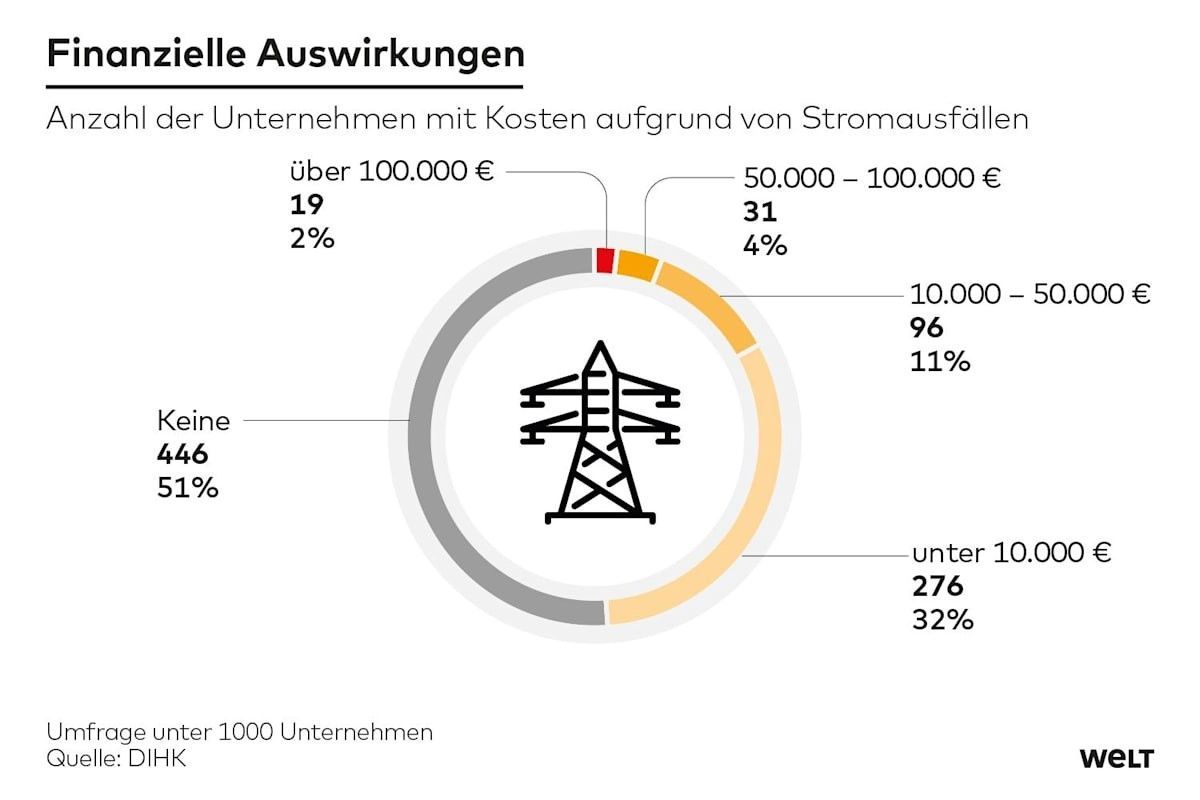
Even brief interruptions can be costly: around one-third of companies expect additional costs of up to €10,000 per incident—with figures often significantly higher in the industrial sector. Added to this are risks such as machinery damage, data loss, and consequential costs due to contractual delays.
Particularly critical: in complex production environments, "domino effects" loom—for instance, when suppliers or logistics partners are affected simultaneously.
Cybersecurity as a Key Factor
In addition to physical risks, the threat of cyberattacks is growing. Hacker groups are increasingly targeting energy providers and industrial control systems. An attack can have the same effect as a power failure—with the crucial difference that the cause and duration often remain unclear.
Companies should therefore align their contingency plans with at least 16 scenarios, ranging from short-term interruptions to multi-day systemic failures.
Societal Risks: When Stability Falters
If the power supply fails over an extended period, societal structures also come under pressure. After 48 to 72 hours, there is a heightened risk of vandalism, looting, and logistical bottlenecks.
Therefore, companies must implement not only technical but also organizational and security-related precautions—such as plant security, access control, and the maintenance of critical infrastructure.
No "One-Size-Fits-All" Solution – But Clear Responsibility
Every company requires a bespoke crisis concept tailored to its specific structure. Standardized plans fall short. The central task of management is to define responsibilities, secure decision-making paths, and ensure resources can be deployed effectively in an emergency.
The bottom line is clear:
Resilience is not a matter of chance; it is the result of strategic preparation. Those who invest today in emergency power, communication security, and crisis organization are securing their operational continuity—and thus the future of their business.
What are the consequences of a power outage?
A power failure affects numerous areas of daily life that directly impact business operations—including transportation, telecommunications, and various utility systems. If power is lost for an extended period, maintaining standard operations becomes increasingly difficult. Significant disruptions or total failures are most likely to occur in:
- Fixed-line telephony, mobile networks, internet, and data connectivity
- Battery-powered devices such as laptops and smartphones
- Electronic alarm, locking, and access control systems
- Monitoring, security, and industrial control systems (ICS)
- Office equipment, data centers, and server facilities
- Fuel supply and transport logistics
- Banking and financial systems
- Water supply and wastewater management
- General and emergency lighting
- Ventilation, air conditioning, refrigeration, process control systems, and fire alarms
- Heating systems and circulation pump
- Passenger elevators
Source: IHK Elbe-Weser
Blackout Risk: Why Management Must Take Responsibility Now
Extreme weather, geopolitical uncertainties, and the restructuring of the energy system are fundamentally changing the risk landscape of the German economy. The probability of large-scale power outages is rising—with potentially life-threatening consequences for companies. While public discussion on the matter remains rather subdued, awareness is growing in the executive suites: security of supply is a top-level priority.
Blackout Simulation – Putting Reality to the Test
A crisis management exercise is underway in a conference room at a German industrial park. While wind turbines outside supply green energy, the scenario inside takes a critical turn: a control unit in the substation suddenly fails. Power outage. Within seconds, production grinds to a halt and communication systems collapse.
This simulation demonstrates how rapidly a local incident can escalate into a company-wide crisis—and underscores the vital importance of established decision-making structures.
Preparing for a crisis? Let us advise you!